









So, you've seen those big, bouncy balls at the gym and wondered if they're actually worth the hype? Well, let me tell you, incorporating exercise with a fitness ball into your routine can be a total game-changer. It's not just about looking good; it's about building a strong, stable body that can handle whatever life throws at you. Whether you're a total beginner or you've been working out for ages, this guide is here to walk you through how to use that ball to really get your core working.
Key Takeaways
- A fitness ball makes your core muscles work harder because it's an unstable surface, forcing you to balance.
- Choosing the right size ball is important; your knees should be at a 90-degree angle when you sit on it.
- Start with basic exercises like crunches and bridges on the ball to build a solid foundation.
- Focus on proper form and controlled movements to get the most out of your exercise with a fitness ball and avoid injury.
- Using a fitness ball can improve posture, balance, and coordination, not just give you a toned midsection.
Understanding Your Core and The Fitness Ball
Defining Your Body's Control Center
Think of your core as the central hub for all your body's movements. It's not just about having a six-pack; it's a complex network of muscles that includes your abs, obliques, lower back, hips, and even your glutes. This group of muscles is responsible for stabilizing your spine, maintaining good posture, and allowing you to move with control and efficiency. When your core is strong, everyday tasks become easier, and you're better protected against injuries, especially in your back. It's the foundation upon which all other physical activities are built.
How The Ball Enhances Core Engagement
So, how does a big, wobbly ball make your core work harder? It's all about instability. When you sit on it, lie on it, or perform exercises using it, the ball constantly shifts and rolls. To stay balanced on this unpredictable surface, your core muscles have to fire up and work overtime. They're constantly making tiny adjustments to keep you upright and stable. This is different from exercising on a solid floor, where your muscles don't have to work as hard to maintain stability. The fitness ball essentially turns every movement into a balance challenge, forcing deeper core muscles to engage.
Choosing The Right Size Fitness Ball
Getting the right size fitness ball is pretty important for both comfort and effectiveness. Using a ball that's too big or too small can throw off your form and even lead to strain. Here's a simple way to check:
- Sit on the ball with your feet flat on the floor.
- Your knees should be bent at about a 90-degree angle, roughly level with your hips.
If your knees are significantly higher than your hips, the ball is too big. If your hips are higher than your knees, the ball is too small. Generally, taller individuals will need larger balls, while shorter individuals will need smaller ones. Most manufacturers provide sizing charts based on height, which can also be a helpful guide.
Picking the correct ball size is the first step to a safe and effective workout. It ensures you can maintain proper alignment and get the most out of each exercise without unnecessary strain.
Foundational Exercises With A Fitness Ball
Alright, so you've got your fitness ball and you're ready to actually use it. This isn't just some fancy pillow for your office chair; it's a tool that can seriously change up your regular fitness routine. Think of it as a way to add a little challenge and get more muscles working during exercises you already know. It's all about making your workouts more dynamic and getting more out of them, muscle-wise.
Getting started with the ball doesn't have to be complicated at all. You can easily add it to exercises you already do to make them tougher. The instability means your body has to work harder just to keep you steady. This is where you really start to feel the burn and see the gains. These are your starting points, the bread and butter of stability ball training. They're designed to get you a feel for how the ball moves and how your body has to react to stay balanced. Focus on smooth, controlled movements and really pay attention to feeling those core muscles engage. Don't worry about speed; good form is way more important right now.
Basic Ball Crunches For Abdominal Strength
This is a classic for a reason. It takes the standard crunch and adds an element of instability that really makes your abs work harder to keep you stable.
- Setup: Sit on the ball with your feet flat on the floor, about hip-width apart. Slowly walk your feet forward, letting the ball roll under your back until you're in a stable, reclined position. Your lower back should feel supported by the ball, and your feet should be firmly planted.
- Execution: You can place your hands lightly behind your head (don't pull on your neck!) or cross them over your chest. As you exhale, lift your head and shoulders off the ball, squeezing your abdominal muscles. Think about bringing your rib cage towards your hips. Inhale as you slowly lower back down to the starting position.
- Focus: Concentrate on feeling the contraction in your abs. Avoid using momentum. The movement should be controlled and deliberate.
Ball Bridges For Glute and Lower Back Support
This exercise is fantastic for strengthening your glutes, hamstrings, and lower back, all while your core works to keep your hips level and stable.
- Setup: Lie on your back on the floor with your legs extended and your heels resting on top of the fitness ball. Your knees should be bent at about a 90-degree angle when you lift your hips.
- Execution: Engage your glutes and core, then lift your hips off the ground until your body forms a straight line from your shoulders to your knees. Squeeze your glutes at the top. Hold for a moment, then slowly lower your hips back down without letting them touch the floor.
- Tip: The further your feet are from your hips on the ball, the more challenging it will be. Keep your neck relaxed and your gaze pointed towards the ceiling.
Seated Ball Bounces For Stability Practice
This might seem simple, but it's a great way to get comfortable with the ball's movement and build basic core awareness.
- Setup: Sit upright on the ball with your feet flat on the floor, hip-width apart. Ensure you have good posture – chest up, shoulders back.
- Execution: Gently bounce up and down on the ball. As you bounce, focus on engaging your core muscles to maintain your balance and control. You can gradually increase the height of the bounce as you feel more stable.
- Progression: Once you're comfortable, try small movements side-to-side or forward-and-back while maintaining the bounce. This helps develop dynamic stability.
Remember, the instability of the exercise ball forces your stabilizing muscles, especially those in your core, to work much harder than they would on a solid surface. This means you're getting a more complete workout, even with simple movements. Start slow, focus on form, and gradually increase the challenge.
Advanced Core Training Using The Fitness Ball
Alright, so you've got the basics down with the fitness ball, and you're ready to really push your core to the next level. That's awesome! Moving into more advanced exercises means you're going to be challenging your stability and strength in new ways. It's not just about looking good; it's about building a seriously strong and resilient midsection that helps with pretty much everything you do.
Plank Variations On The Ball
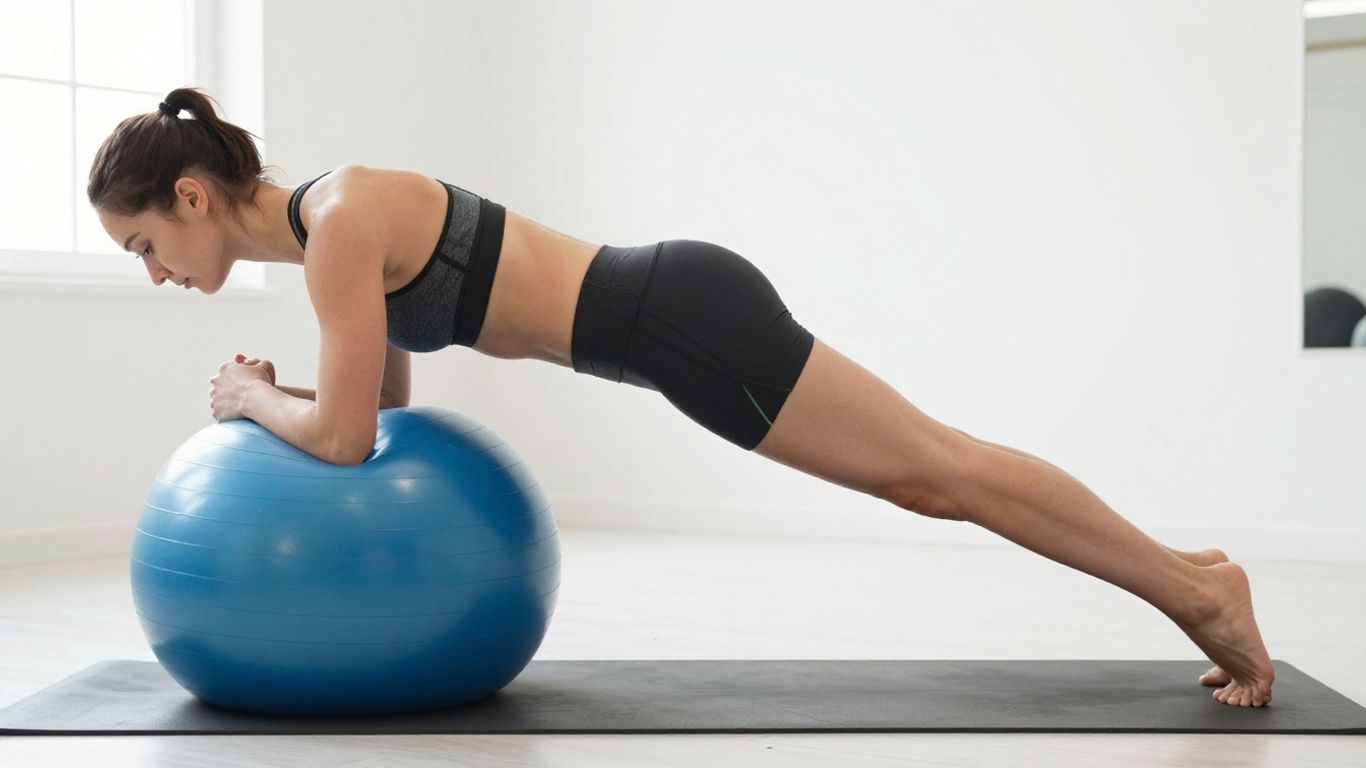
Planks are already a go-to for core work, but putting your body on a wobbly ball? That's a whole different ballgame. You can try a few different things here. The classic forearm plank is a good start, but you can make it harder by placing your feet on the ball instead of your hands. This forces your core to work overtime to keep your body steady. Another option is to do a standard plank on the floor and then place your forearms on the ball. This requires a lot of control to prevent the ball from rolling away. The key here is to keep your body in a straight line from head to heels, no sagging hips or piking up.
Here are a few ways to mix it up:
- Feet on Ball Plank: Start in a push-up position, but place your shins or feet on top of the ball. Hold your body straight and engage your abs.
- Forearms on Ball Plank: Get into a forearm plank position, but rest your forearms on the top of the ball. This is tough!
- Plank with Ball Pass: While in a forearm plank on the floor, reach one hand to the ball and gently tap it, then switch hands. This adds a rotational challenge.
Ball Roll-Outs For Deep Core Activation
This exercise is a real test of your deep abdominal muscles, the ones that really stabilize your spine. You'll typically do this on your knees to start, though advanced folks might do it standing. You kneel in front of the ball, place your hands on it, and then slowly roll the ball forward, extending your arms and torso. As you roll out, your core has to work hard to stop you from collapsing. You want to roll out as far as you can while still being able to pull yourself back using your core strength. Don't let your lower back arch too much; that's a sign you've gone too far or need to engage your core more. It feels like your abs are on fire afterward, in a good way.
Stability Ball Pass-Overs For Oblique Engagement
Want to work those side abs, your obliques? This move is perfect. You lie on your back with the ball held between your feet or ankles. Then, you lift your legs and the ball up towards your chest, passing the ball from your feet to your hands. Once you have the ball in your hands, you lower your legs back down (without touching the floor) and then pass the ball back to your feet. It's a continuous motion that really targets the obliques as you twist and stabilize your torso. It takes some coordination, so don't worry if it feels a bit awkward at first. Just focus on controlled movements and keeping your lower back pressed into the floor.
Remember, when you're doing these advanced moves, form is way more important than how many reps you do. It's easy to cheat and let your body compensate, but that's how you get hurt. Slow and steady wins the race here, building real strength without the risk.
Maximizing Your Fitness Ball Workouts
So, you've got your fitness ball and you're ready to really mix things up. That's great! This ball isn't just for sitting or doing basic crunches; it's a tool that can seriously spice up your regular fitness routine. Think of it as a way to add a little challenge and a lot more engagement to exercises you already do. It's all about making your workouts more dynamic and getting more out of them, muscle-wise.
Proper Form and Technique
This is probably the most important part. It's easy to get excited and want to do everything at once, but that's how injuries happen. The key is slow and steady progress. Focus on doing the exercises correctly. It's better to do fewer reps with good form than many with bad form. Maintaining alignment is key for effectiveness and injury prevention. You want to feel the muscles working, not just going through the motions. Remember, the ball is wobbly! When you sit or move on it, it shifts around. This forces your deeper core muscles to constantly work to keep you balanced. It's like a mini-workout for your stability muscles happening all the time you're using the ball.
Slow, controlled movements yield better results than fast-paced routines where you’re simply going through the motions. Engage your core throughout each exercise for maximum impact.
Consistency For Optimal Results
To get the most out of your fitness ball workouts, consistency is key. Try to incorporate it into your routine at least three times a week. This frequency helps build strength while allowing your body to adapt. Gradually increase how many reps you do or how long you hold a position. Your body will tell you when it's had enough. Pushing through sharp pain is never a good idea. It's better to back off, rest, and try again when you're feeling stronger. Consistency over intensity is the name of the game here. You can also track your progress regularly. Noticing improvements in balance, flexibility, or strength can motivate you to stick with it and strive for even greater achievements.
Here’s a simple way to think about increasing difficulty:
- Increase Reps: If you're doing 10 reps of an exercise, try for 12 or 15.
- Increase Hold Time: For exercises like planks or holds, extend the duration by 5-10 seconds.
- Add Resistance: Use light weights or resistance bands alongside the ball.
- Reduce Base of Support: Make the exercise harder by bringing your feet closer together or lifting one limb.
Integrating Ball Exercises With Other Training
Don’t forget to pair core ball exercises with other training methods like resistance bands or weights. This combination can enhance overall strength and endurance, pushing you closer to your fitness goals. Vary your workouts to keep things interesting and challenge different muscle groups. Combine stability exercises with dynamic movements for a full-body experience that keeps you engaged. This approach ensures you're not just working your core but also building a well-rounded physique.
Avoiding Common Pitfalls With Ball Exercises
Alright, so you've got your fitness ball, and you're ready to get to work. That's awesome! But before you dive headfirst into a bunch of new moves, let's chat about a few things that can trip people up. It's easy to make mistakes when you're learning, and with a fitness ball, some of those slip-ups can actually make the exercise less effective or, worse, lead to a tweak or strain. We want to avoid that, right?
The Importance Of Proper Alignment
This is a big one. When you're on the ball, your body naturally wants to find the easiest way to do things. That might mean your hips sag in a plank, or your back rounds during a crunch. Keeping your body in a straight line, from your head to your heels, is key for most exercises. Think of it like building a sturdy tower – everything needs to be stacked up right. If you're not aligned, you're not really working the muscles you intend to, and you're putting extra stress on parts of your body that don't need it.
Here's a quick rundown of what good alignment often looks like:
- Core Engaged: Imagine gently pulling your belly button towards your spine. This isn't about sucking in, but about creating a stable core.
- Neutral Spine: Avoid arching your lower back too much or letting it round excessively. It should feel like a natural, straight line.
- Shoulders and Hips Square: In positions like planks or bridges, try to keep your shoulders and hips facing the same direction, not twisting.
When you're first starting, it's super helpful to use a mirror or even record yourself. Seeing your form can be a real eye-opener and help you catch those little deviations before they become habits.
Selecting The Correct Ball Size
This might seem obvious, but it's really important. Using a ball that's too big or too small can throw off your entire workout. If the ball is too small, your hips might end up lower than your shoulders in certain exercises, which isn't ideal. If it's too big, you might not get the full range of motion you need.
Here’s a general guide based on height:
| Height (ft) | Ball Diameter (cm) |
|---|---|
| 4'11" - 5'4" | 45-55 |
| 5'5" - 5'11" | 55-65 |
| 6'0" - 6'4" | 65-75 |
Remember, this is a starting point. Your personal comfort and the specific exercises you're doing can influence what feels best. If you're unsure, try to test out a few sizes if possible.
Focusing On Controlled Movements
It's tempting to rush through exercises, especially when you're feeling motivated. You might think doing more reps faster means you're getting a better workout. But with a fitness ball, that's usually not the case. The ball adds an element of instability, and if you move too quickly, you lose control. This means you're not really challenging your core muscles effectively, and you increase the risk of losing balance or form.
Instead, aim for slow, deliberate movements. Focus on the muscles you're supposed to be working. Feel the engagement. This approach not only makes the exercise safer but also much more effective for building strength and stability. Think quality over quantity, always.
Benefits Beyond A Sculpted Midsection
Sure, getting a six-pack is a common goal, and fitness balls can definitely help with that. But honestly, the advantages of working with a stability ball go way beyond just looking good in a swimsuit. It's about building a stronger, more resilient body from the inside out.
Improving Posture and Back Support
Think about how much time we spend sitting these days. It really does a number on our posture, right? Using a fitness ball can help counteract that. When you sit on the ball, even just for a bit, your body naturally has to make small adjustments to stay balanced. This constant micro-movement wakes up the muscles along your spine and in your lower back. Over time, this leads to better alignment and less slouching. A more upright posture not only makes you look more confident but can also reduce strain on your neck and shoulders.
Enhancing Balance and Coordination
Working with an unstable surface like a fitness ball is like a constant, low-level challenge for your balance. Every exercise, whether it's a simple crunch or a more complex move, forces your body to work harder to stay steady. This is especially true for your core muscles, which are the command center for stability. As you get better at balancing on the ball, you'll notice improvements in your overall coordination, which can translate to better performance in sports and everyday activities. It's like training your brain and body to work together more efficiently.
Reducing Risk of Injury
When your core is strong and your body is well-balanced, you're naturally less prone to injuries. A stable core acts like a natural brace for your spine, protecting it during sudden movements or when lifting heavy objects. The improved coordination from ball exercises also means you're less likely to stumble or fall. Think of it as building a more robust physical foundation that can handle life's little (and big) surprises.
Here's a quick look at how ball work helps:
- Better Spinal Alignment: Encourages a neutral spine position.
- Increased Proprioception: Your body becomes more aware of its position in space.
- Stronger Stabilizing Muscles: These often-neglected muscles get a good workout.
- Improved Movement Patterns: Leads to more efficient and safer movements overall.
The real magic of the fitness ball isn't just about the immediate muscle burn. It's about the lasting changes it creates in how your body functions. You're not just building muscle; you're building a better, more capable version of yourself that's ready for anything.
Wrapping It Up
So, you've learned a lot about using that big ball for your core. It's not just a fancy piece of equipment; it's a solid way to get stronger and more stable. Remember to start with the basics, pick the right size ball, and really focus on how you're moving. Don't rush it. Building a strong core takes time, but with this ball, you've got a great tool to help you get there. Keep at it, and you'll notice a difference in how you feel and move every day. It’s pretty cool what a simple ball can do.
Frequently Asked Questions
What is my 'core' and why is it important?
Your core is like your body's command center. It includes muscles in your belly, back, hips, and pelvis. A strong core helps you stand up straight, keeps your spine safe, and allows you to move smoothly. It's the base for everything you do, from carrying groceries to playing sports.
How does a fitness ball make my core work harder?
The ball is wobbly! When you sit or move on it, it shifts. This makes your deeper core muscles work constantly to keep you balanced. It's like a mini-workout for your stability muscles happening all the time you're using the ball.
How do I pick the right size fitness ball?
You want to have a 90-degree bend in your knees when you sit on it with your feet flat on the floor. If your knees are higher than your hips, the ball is too big. If your hips are higher than your knees, it's too small. Generally, taller people need bigger balls.
Can basic exercises on the ball give me a good workout?
Absolutely! Simple moves like crunches or bridges on the ball are much tougher than doing them on the floor because you have to focus on balance. These basic moves are great for building a solid foundation for your core strength.
What are some advanced ways to use the ball for my core?
Once you're comfortable, try plank variations with your hands or feet on the ball, or ball roll-outs. These moves really challenge your stability and engage those deep core muscles even more intensely.
How can I use the ball safely and avoid getting hurt?
Start slow and focus on doing the exercises correctly. It's better to do fewer reps with good form than many with bad form. Gradually increase how many reps you do or how long you hold a position. Most importantly, listen to your body – don't push through sharp pain.


0 comments