So, you've got a trampoline and you're ready to move beyond just basic bouncing? Awesome! Learning some cool tricks can make your time on the trampoline way more exciting. Whether you're just starting out or you've been jumping for a while, there are plenty of fun and relatively easy tricks on the trampoline that you can learn. We'll walk through some of the best ones to get you bouncing like a pro in no time. Get ready to impress yourself and anyone watching!
Key Takeaways
- Start with basic drops like the Seat Drop and Knee Drop to get comfortable with landing in different positions.
- Master foundational jumps like the Tuck Jump, Pike Jump, and Straddle Jump to improve air awareness and control.
- Progress to simple rotations with the Half-Turn Jump before attempting more complex flips.
- Focus on controlled bounces and maintaining good posture throughout each trick.
- Always prioritize safety: jump one at a time, ensure the trampoline is in good condition, and consider a spotter for advanced moves.
Seat Drop
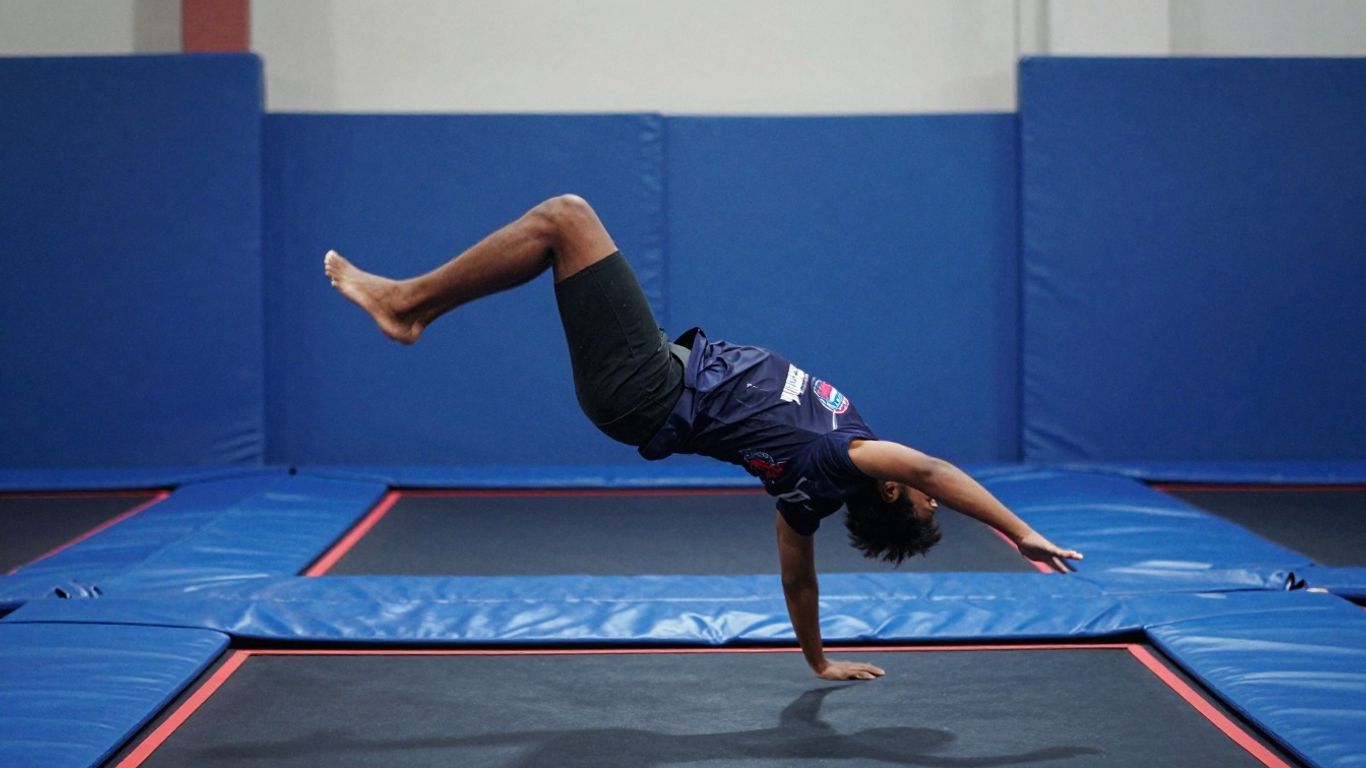
Alright, let's talk about the Seat Drop. This is a super common move and a great one to get the hang of early on. Basically, you're going to jump up and land right on your backside. Sounds simple, right? Well, there's a little more to it than just plopping down.
Here’s how to get it right:
- Start with a gentle bounce. You don't need a ton of height for this one. Just a nice, controlled bounce to get you airborne.
- As you go up, bring your legs out straight in front of you. Think about pointing your toes towards the ceiling. Keep them together.
- Land on your butt. Try to land in the same spot you jumped from. Your hands can lightly touch the mat behind you for a little balance, but don't lean on them too hard.
- Rebound back to your feet. From the seat drop, use the bounce to push yourself back up to a standing position. Keep those legs straight out in front as you come up.
The key is to keep your body controlled throughout the whole movement. You want to land softly on your seat and then use that bounce to smoothly return to standing, not just collapse.
A common mistake is leaning too far forward or backward. Try to keep your core engaged and your body relatively upright as you land on your seat. Also, avoid slapping your hands down hard; they're just there for a little stability, not to catch your whole weight.
Tuck Jump
Alright, let's talk about the tuck jump. This is a pretty classic move and a really good one to get down early on. It’s all about controlling your body in the air, which is super important for pretty much everything else you'll want to do on a trampoline.
So, how do you do it? Start with a good, solid bounce – nothing too crazy, just enough to get you a decent height. As you reach the very top of your bounce, that's your cue. You want to pull your knees up towards your chest as fast as you can. Think about hugging them in tight. Some people like to grab their shins, others just keep their hands by their hips. The key is to make your body as compact as possible, like a little ball.
Here’s a quick breakdown:
- Get a steady bounce: Don't go for maximum height right away.
- Peak of the bounce: This is when you act. Pull those knees in.
- Compact yourself: Make your body as small as possible.
- Quick release: As soon as you've tucked, extend your legs back down for your landing.
The faster and tighter you pull your knees in, the more momentum you'll generate, which is what helps you get more height on your next bounce and sets you up for more advanced tricks. It might feel a little awkward at first, but practice makes perfect. You'll want to land in a similar stance to how you took off, nice and tall.
A common pitfall is tucking too early or holding that tucked position for too long. You really want to wait until you're at the absolute highest point of your jump before you pull in. This ensures you're using the airtime effectively and not cutting your bounce short. Getting this timing right is a big step towards mastering trampoline tricks.
Don't worry if you don't nail it on the first try. It takes a bit of coordination and practice to get the timing just right. Just keep at it, focus on that tight pull and quick release, and you'll be tuck jumping like a pro in no time.
Pike Jump
Alright, let's talk about the pike jump. This one is pretty cool because it really works on your core strength and helps you get more flexible. It’s a step up from the basic tuck jump, asking you to keep your legs straight as you bring them up.
To do it, you start with a good, solid bounce. As you reach the peak of your jump, lift both of your legs straight out in front of you. The goal is to get them parallel to the trampoline surface, making your body look like an 'L' shape. While your legs are up there, try to reach your hands towards your toes. Keep your back straight the whole time – no hunching over! Point those toes and keep those legs squeezed together.
Here’s a quick breakdown:
- Takeoff: Get a strong, straight bounce.
- In the Air: Lift both legs straight out in front, aiming for hip height or higher.
- Form: Keep your legs straight, point your toes, and reach your hands towards them. Your body should form an 'L'.
- Landing: Bring your legs back down and land in a controlled standing position.
It might feel a bit awkward at first, especially if your hamstrings are a bit tight. Don't worry if your pike isn't perfect right away. Just focus on keeping those legs straight and your core tight. You can even work on your flexibility off the trampoline to help with this move.
The key here is control. You want to be able to hold that 'L' shape for a moment before bringing your legs back down for a clean landing. It’s all about body awareness and building that muscle memory for more complex moves later on.
Straddle Jump
Alright, let's talk about the straddle jump. This one is pretty cool because it looks impressive and it's a bit easier on your hamstrings than, say, a pike jump. The basic idea is to jump up and spread your legs out to the sides, like a wide 'V'. While you're up there, you can reach your hands towards your toes, but keep those legs straight! It's all about coordination and getting that hip flexibility going.
Here’s a quick breakdown of how to get it right:
- Get a good bounce: Start with a steady, controlled bounce. You want enough height to comfortably get your legs out.
- The jump: At the peak of your bounce, push off and spread your legs wide to the sides. Keep your back straight and chest up. Point your toes outward a bit and really feel those inner thigh muscles working.
- The reach (optional): If you can, reach your hands towards your feet. Don't force it, though. The main goal is the leg spread.
- The landing: Bring your legs back together before you hit the mat. Land softly, absorbing the impact with slightly bent knees.
This trick is fantastic for building hip strength and control, which is super helpful for more complicated moves down the line. Don't worry if your first few attempts aren't super wide; just focus on the shape and bringing your legs back together smoothly. You can gradually increase how wide you spread your legs as you get more comfortable and flexible. It’s a great way to add some flair to your trampoline routine.
Remember, consistency is key. Practice the straddle jump regularly, focusing on form over height initially. As your flexibility improves, you'll naturally get a wider and more impressive straddle. It’s a fun way to challenge your body and see progress.
Knee Drop
Alright, let's talk about the knee drop. This one's pretty straightforward and a good way to get used to landing on something other than your feet. You'll want to start with a decent, controlled bounce – not too high, not too low. As you come up, bring one knee towards your chest, keeping the other leg mostly straight and pointing your toes down. Your hands will naturally reach forward a bit to help you keep your balance.
The key is to land on that bent knee and the shin of the same leg, with your hands hitting the mat at the exact same time. This is what helps you stabilize. Once you've made contact, push off immediately with both your hands and your feet to get back up to a standing position. It feels a little weird at first, but it's all about getting that coordination down.
Here's a quick breakdown:
- Initial Bounce: Get a comfortable, steady bounce going. Don't go for maximum height yet.
- The Drop: As you rise, bend one knee towards your chest. Keep the other leg extended and point your toes.
- Landing: Aim to land on your bent knee and shin simultaneously with your hands. This is your stabilization point.
- Rebound: Push off with your hands and feet to spring back to your feet.
It's a good idea to start with whichever knee feels more natural to drop onto. Once you've got that down, switch and practice with the other knee. This trick is super helpful for learning how to land safely on different parts of your body, which is a big deal, especially if you're in a place with lots of different jumping zones.
This move teaches you to control your body's descent and use your hands for support, a skill that translates to many other trampoline tricks. It's all about controlled impact and quick recovery.
Back Drop
Alright, let's talk about the back drop. This one feels a little more daring than the seat drop, but it's totally doable once you get the hang of it. It's basically about landing on your upper back and using that bounce to get you back up.
Here’s how to get started:
- Get a good bounce going. Start with some regular jumps, getting a feel for the trampoline. You want enough height to feel comfortable, but not so much that you lose control.
- Lean back at the peak. As you reach the highest point of your jump, gently lean your upper body backward. Think about looking up at the ceiling.
- Tuck your chin and knees. To protect yourself, tuck your chin towards your chest. At the same time, bring your knees up towards your body. This helps create a curved shape.
- Land on your upper back. Aim to land on the fleshy part of your upper back, around your shoulder blades. Definitely avoid landing on your neck or lower back. Your arms can spread out a bit to help with balance.
- Use the bounce to return. The trampoline will do most of the work here. Let the bounce lift you back up. As you come up, swing your arms forward and pull your body upright to land back on your feet.
It's super important to have plenty of clear space around you for this one. No one else should be on the trampoline or too close by when you're trying it out. Safety first, always!
The key is to relax into the movement rather than fighting it. If you tense up, it's harder to get that nice curved shape and you might land awkwardly. Practice makes perfect, so don't get discouraged if it takes a few tries.
Front Flip
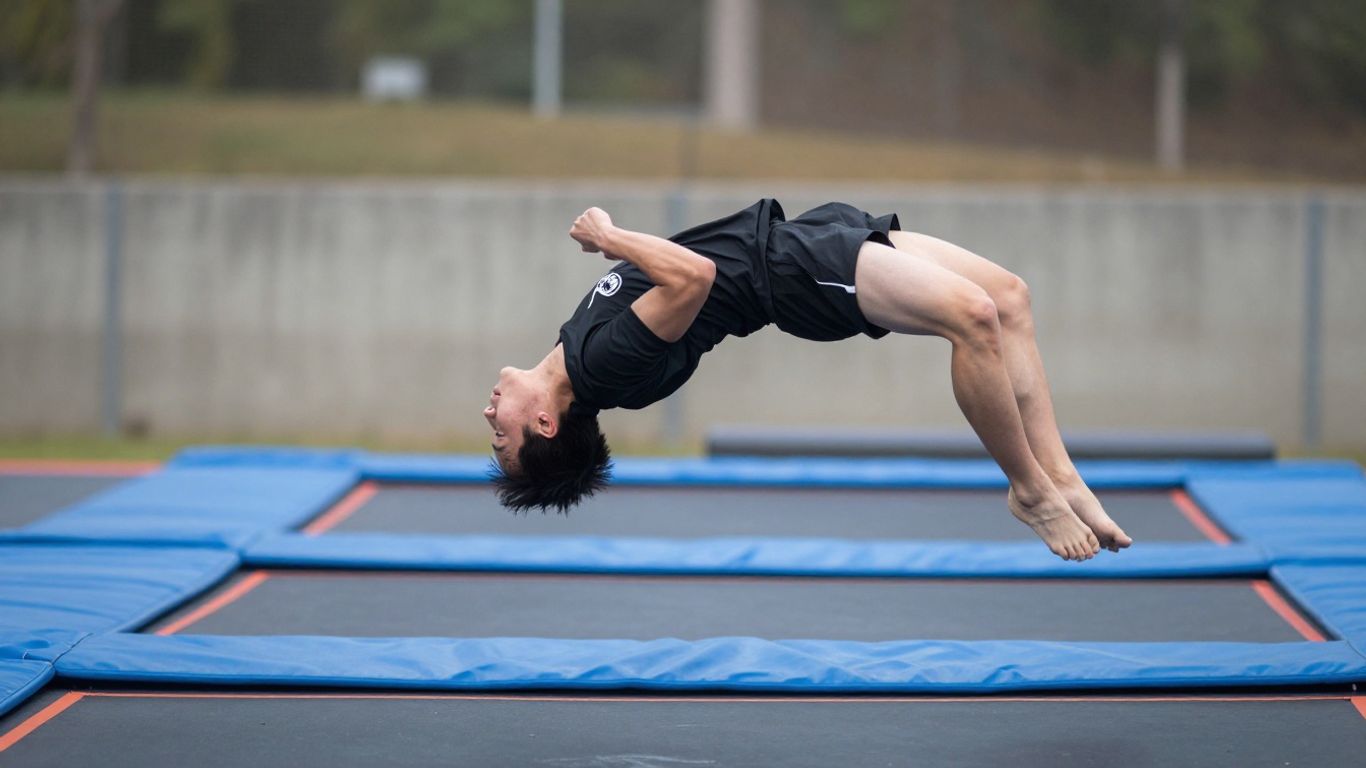
Alright, let's talk about the front flip. This one can feel a little intimidating at first, mostly because you're not really seeing where you're going. It's a full rotation forward, kind of like a somersault but in the air. The trick is getting enough height and then tucking in tight to spin fast.
Here's a breakdown of how to approach it:
- Get a good, strong jump straight up. You need that height to give yourself time to rotate. Think about pushing off the trampoline bed with all your might.
- Initiate the rotation. As you reach the peak of your jump, bring your chin towards your chest and swing your arms forward and down. This helps get you spinning.
- Tuck tightly. Pull your knees up to your chest. The tighter you are, the faster you'll spin. This is super important for getting around.
- Spot your landing. As you come around, try to see the trampoline bed. This helps you know when to untuck and prepare to land.
- Land with bent knees. Absorb the impact by bending your knees as you touch down. This is key to staying safe and not hurting yourself.
The biggest hurdle with the front flip is often psychological; you have to trust the process and your ability to rotate without seeing your landing the whole time. It takes practice, and starting with a spotter or in a safe environment like a foam pit is a really good idea if you can. Don't rush into it; master the basic jumps and tucks first. Once you get the hang of it, you can start thinking about variations like adding twists or doing multiple flips, but for now, focus on getting that clean, single front flip down.
Back Flip
Alright, let's talk about the back flip. This is the one that often gets people a little nervous, but honestly, most find it easier than a front flip once they get the hang of it. It's all about that backward rotation. You want to get a good, solid jump going first. Think about throwing your arms up and back, and letting your head follow. This helps get that backward momentum.
Here's a breakdown of what to focus on:
- Get enough height: Don't rush the flip. You need a good bounce to give you time to rotate. Aim for at least a few feet of airtime.
- Tight tuck: Once you're in the air, pull your knees up to your chest. A tight tuck makes you spin faster, which is exactly what you want.
- Spot your landing: As you come around, try to see the trampoline bed. This helps you know when to untuck and prepare for landing.
- Land soft: Always land with your knees bent. This absorbs the impact and keeps you from bouncing away unexpectedly.
The key is timing your jump and rotation just right. Too early, and you won't get high enough. Too late, and you might not complete the flip. It takes practice, so don't get discouraged if your first few attempts aren't perfect.
Many people find it helpful to start with a spotter or in a place with safety mats. Some trampoline parks even have programs that guide you through the steps safely. It's a good idea to get comfortable with basic backward movements, like jumping onto your back and then pushing back up to your feet, before you go for the full flip.
Once you've got the basic back flip down, you can start thinking about variations. You can do multiple flips in a row, or add twists. A back flip with a half twist, for example, involves spinning horizontally as you rotate backward. Mastering these takes even more practice, but it's super rewarding!
Side Flip
Alright, let's talk about the side flip. This one's a bit of an oddball in the trampoline world, not something you see every day, and honestly, not super common even among the pros. It's more of a fun trick for people who've been bouncing around for a while and want to try something a little different.
Think of it like a front flip, but instead of going straight over your head, you're rotating sideways. It's not as straightforward as a front or back flip because the angle of rotation is a bit awkward. Most people don't combine it with other tricks because, well, it just doesn't flow very well. You can technically add twists to it, but it's rare, and doing multiple side flips in a row without touching the ground is a serious challenge.
Here's a general idea of how you might approach it:
- Get some good height: Just like any flip, you need to jump high. Aim for a solid, straight bounce first.
- Initiate the rotation: Instead of tucking your chin for a front flip or throwing your head back for a back flip, you'll need to initiate a sideways rotation. This often involves a slight lean and a push off the side of your body as you jump.
- Tuck and rotate: Once you're in the air, pull your knees towards your chest to speed up the rotation. Keep your eyes open as much as possible to spot your landing.
- Spot and land: As you come around, look for the trampoline bed. Try to untuck and land with your knees bent to absorb the impact.
This trick takes a good amount of body awareness and control. It's not about brute force; it's about timing and knowing where your body is in the air. If you're struggling, it might be helpful to practice with a spotter or on a trampoline with extra padding.
It's definitely a trick that requires practice and a bit of bravery. Don't expect to nail it on your first try, but if you're looking for a unique move to add to your repertoire, the side flip is certainly that.
Barani
Alright, so you've been practicing your flips and maybe even got the hang of a basic front flip. Now, let's add a little spice to it. The Barani is basically a front flip with a half twist thrown in. It sounds a bit wild, but it's a really cool move that looks impressive and is a great next step after mastering simpler flips.
Think of it like this: you're doing your front flip, but somewhere in the middle of that rotation, you're going to give your body a little nudge to spin sideways, just a half turn. The key is to initiate the twist as you leave the trampoline, not too early and not too late.
Here's a breakdown of how to approach it:
- Takeoff: Get a good, solid bounce. As you go up, start thinking about your front flip motion, but also prepare for that twist. It's a coordinated effort.
- Rotation & Twist: As you start to flip forward, use your arms and shoulders to help initiate the half twist. Keep your body relatively tight, like you would in a tuck, to help you spin faster.
- Spotting & Landing: This is where it gets tricky. You need to spot your landing area as you come around. Because you're twisting, your body will be moving sideways as well as rotating. Try to land with your feet together, absorbing the impact.
It takes a lot of practice to get the timing right. You might find yourself over-rotating or not twisting enough at first. That's totally normal!
Don't be discouraged if your first few attempts look more like a wobbly front flip than a clean Barani. The coordination between the flip and the twist is what makes this trick challenging, but also so rewarding when you nail it. Focus on one element at a time if you need to – get the front flip solid, then work on adding that half twist.
It's a good idea to have a trampoline with safety netting for this one, just in case you get a bit disoriented mid-air. Safety first, always!
Keep Bouncing!
So there you have it – a handful of tricks to get you started and maybe even impress a few people. Remember, the most important thing is to have fun and stay safe out there. Start with the basics, get a feel for your bounce, and don't rush into anything too wild. Whether you're just getting the hang of a seat drop or dreaming of a backflip, every jump is a step forward. Keep practicing, keep laughing, and enjoy the thrill of mastering the bounce!
Frequently Asked Questions
What's the easiest trick to try first on a trampoline?
For beginners, the seat drop is a great starting point. You land on your bottom with your legs straight out in front of you, then push back up to your feet. It helps you get used to landing and bouncing back up smoothly.
How can I get better at trampoline tricks?
To improve, always start with a good warm-up, like gentle bouncing and stretching your arms and legs. Focus on jumping in the middle of the trampoline, and practice with small, controlled bounces before trying high jumps. Keeping your knees slightly bent when you land and your posture tall is also key.
Is it safe to do flips on a trampoline?
Flips can be exciting, but they are advanced moves. It's best to learn them with a qualified coach in a safe environment, like a trampoline park with nets. Always master the basic jumps first before thinking about flips.
What should I do before trying any trampoline trick?
Before you start any trick, make sure you do a quick warm-up. This means a couple of minutes of easy bouncing and some simple stretches for your ankles and arms. This helps prevent injuries by getting your muscles ready.
How do I keep my balance while jumping?
Keeping your balance is easier when you keep your back straight and your core muscles tight. Look straight ahead at a point in front of you. Use your arms out to your sides like wings to help you stay steady as you go up and down.
What's the difference between a tuck jump and a pike jump?
In a tuck jump, you bring your knees up to your chest and keep your legs close together. For a pike jump, you keep your legs straight and together, and bend forward at your hips to try and touch your toes. Both require good body control, but the pike jump needs more flexibility.




0 comments